AEO, GEO and AIO: What’s the difference?
AEO, GEO and AIO are the new face of discoverability. But what’s the difference between them? And how do you optimise for them?
For years, SEO was the content king. If you could get to the front page of Google, you were golden. That meant hours poured into keyword strategy, meta descriptions, alt text, site structure, internal linking… And more. SEO is a job that’s never done, just maintained.
The main thing is, all that work was worth it, right? Because SEO was one of the most fundamental steps in getting your customers onto your website in the first place. Visibility is everything in ecommerce. And in the not so distant past, towards the end of 2019, Google enjoyed an unshakeable 91% search engine market share. So, SEO was kind of the be-all-and-end-all. If your products weren’t showing up on Google, it was pretty much game over.
But times are a-changing. That’s why you’re reading this blog.
Ecommerce teams can already feel the ground is shifting beneath their feet. The acronyms AEO, GEO, and AIO are floating around at conferences – and anyone who doesn’t know what they mean has got major FOMO.
As we saw in 2025, AI search tools are growing fast. With this growth, it’s becoming ever more important to start figuring out this new world of search.
Because, let’s make no mistake, we really are witnessing a new world of search here. As of October 2025, ChatGPT already boasted over 800 million weekly users. Looking ahead, Gartner predicts traditional Google search volume will drop a further 25% within the year, as AI chatbots and virtual agents start to take over in earnest. And AI Search traffic converts at 14.2% compared to Google’s 2.8%, showing this traffic is dramatically more valuable.
What does this mean for Ecommerce?
Well, as you’ve probably understood, it’s suddenly very, very important to start thinking about AEO, GEO, and AIO. But what are they? What do they mean? And are they really so different from SEO in practice?
Before I go any further, I do want to call out that this is still an emerging field, and as such, there’s still plenty of ongoing debate, discussion and negotiation around these terms. Some people even argue that all three labels – AEO, GEO and AIO – essentially just mean the same thing. With all this in mind, I’ve tried to stay faithful to the most accepted common consensus, with an eye to how the terminology appears to be developing. Watch this space though, because we’re dealing with a marketing discipline in its very infancy.
And with that out of the way, let's get into brushing up on some definitions.
What is GEO?
GEO stands for Generative Engine Optimisation. It’s probably the most widely-used of the new AI Search Optimisation labels.
GEO means optimising your content so that AI tools like ChatGPT, Perplexity and Claude are more likely to cite, quote or summarise it to users. Your content needs to feel authoritative and complete, as the LLMs prioritise depth and context, brand consistency, and originality. In this sense, it’s quite similar to the E-E-A-T principles of SEO, and you can absolutely take these as a guide.
Typical GEO strategies emphasise content value and legitimacy, using tactics like enriched product data, reviews, and solid internal linking structure. Using natural language is really important here, matching the way users ask long-tail questions in ChatGPT.
For solid GEO in an ecommerce context, try to maintain a natural and authentic brand voice, audience-specific product use cases, and trust signals like ingredients lists or FAQs.
What is AEO? (And how is it different from GEO?)
AEO stands for Answer Engine Optimisation, and it typically focuses on structuring content for search engines to extract direct answers from.
Now, that might sound suspiciously similar to how I just defined GEO, so let me break it down further.
First of all, while GEO helps your content show up in AI overviews and chatbots, AEO focuses more on bagging you featured snippets, voice search answers (and also some AI overviews).
While GEO is all about being trusted, helping AI tools incorporate your site’s content into new, generated content, AEO prioritises selection in a more targeted sense. It works best for closed questions, lifting an answer from a source pretty much verbatim. Featured snippets, voice search and the like are looking for one extractable chunk of content that directly and unambiguously answers a common user question, prioritising clarity over depth and nuance.
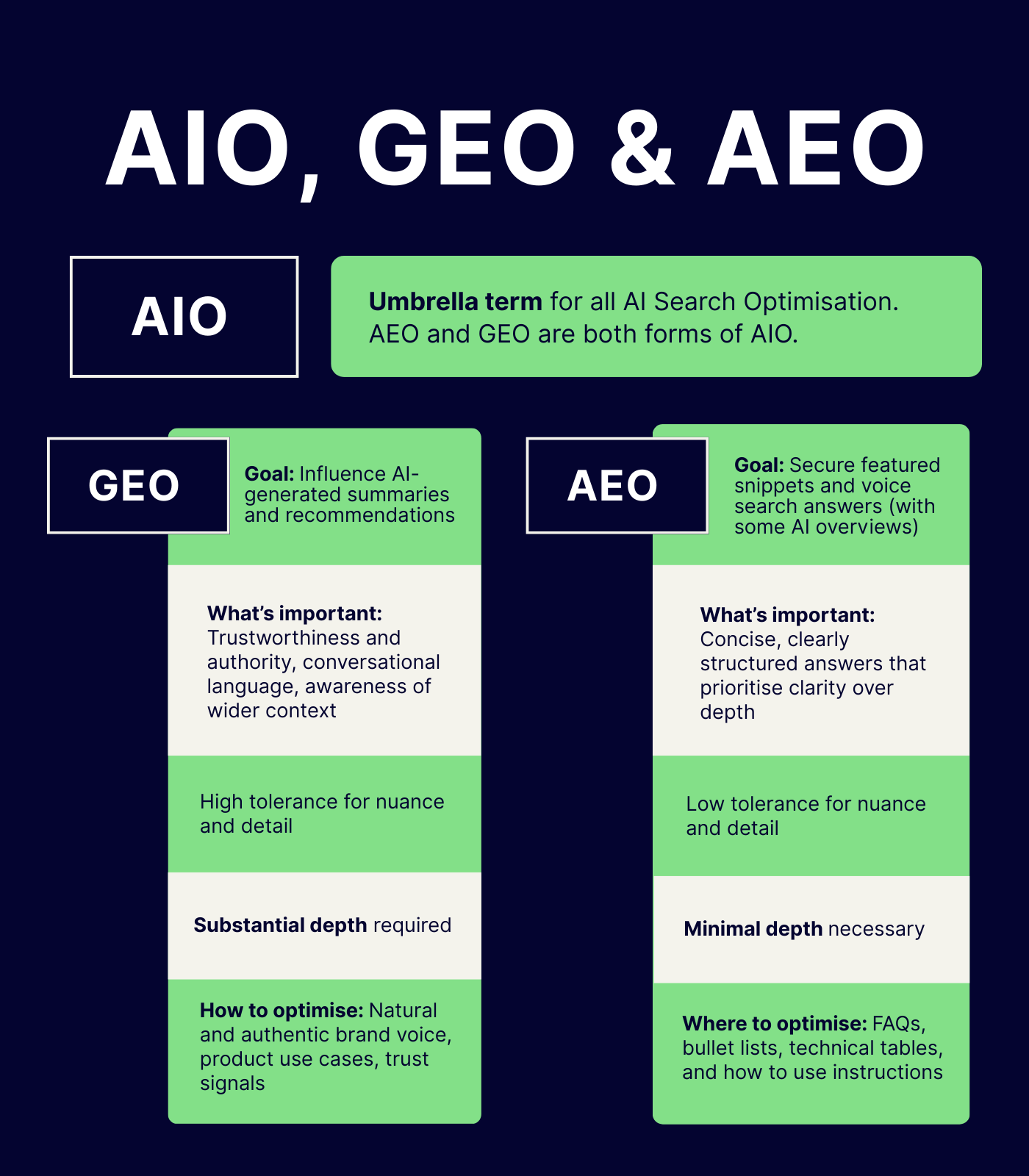
Here’s a quick table to summarise the differences between AEO and GEO.
| GEO Generative Engine Optimisation | AEO Answer Engine Optimisation | |
|---|---|---|
| Goal | Influence AI-generated summaries and recommendations | Secure featured snippets and voice search answers |
| What’s important | Trustworthiness and authority, conversational language, awareness of wider context | Concise, clearly structured answers that prioritise clarity over depth |
| Tolerance for nuance | High | Low |
| Depth required | Substantial | Minimal |
| How / Where to optimise | Natural and authentic brand voice, product use cases, trust signals | FAQs, bullet lists, technical tables, and how-to-use instructions |
FAQs, bullet lists, technical tables, and how to use instructions are all great strategies to win at AEO.
What is AIO?
Good news! AIO is much less confusing than GEO and AEO.
It’s an umbrella term which stands for AI Optimisation, referring to the practice of optimising content for any AI search or answer system. This means that both AEO and GEO can actually both be classed as forms of AIO. If you want to talk about general AI Search Optimisation efforts, AIO is probably the most accurate term to use.
AI Search Optimisation vs Search Engine Optimisation
As we’ve seen, in many ways, SEO and the new world of AI Search Optimisation overlap.
AI search optimisation involves perfecting site structure, maintaining content authority, and so on just like SEO. It involves keyword research, and understanding how users search for products on AI chatbots. (Though, crucially, AI search terms tend to be far longer, and more conversational – questions will be longer and more specific, often 10+ words, compared to traditional search at 3-6 words.)
Just because AIO is the new kid in town, it doesn’t mean teams have to come back to the drawing board empty handed. And, of course, for what it’s worth, SEO is still vital for content success in its own right. The majority of searches still go via Google.
But in 2025, the second most googled term was “ChatGPT”. Just like how, once upon a time, the most searched word on Bing was “Google”. That’s indicative of a change in search habits – and so it should also be an impetus to start expanding the way we optimise for customers. AEO, GEO and AIO are here to stay. It’s time to get a head start on taking them seriously.
Related Posts